What New RVers Often Forget Before Their First Overnight Trip
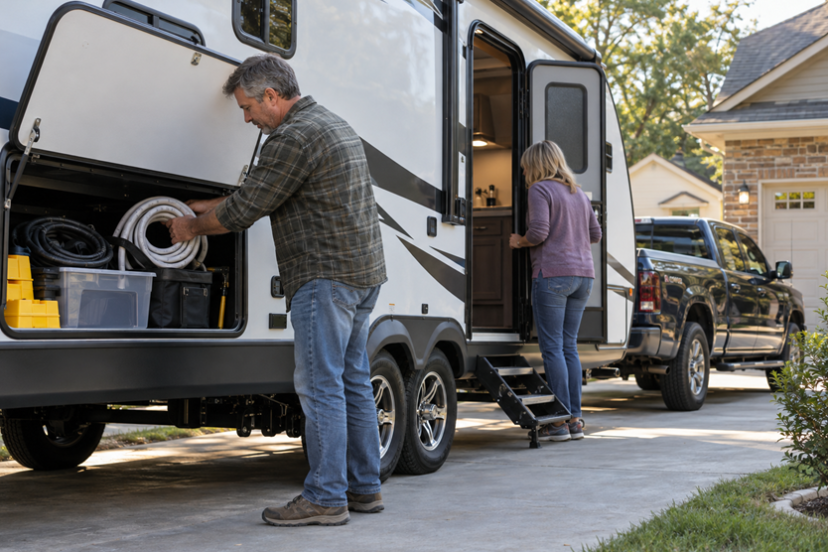
Most first-time RVers remember the obvious things before an overnight trip: food, clothing, bedding, and a destination.
What often gets forgotten are the small details that make the RV itself comfortable and usable once you arrive.
Things like checking whether the refrigerator is ready for food, knowing how you will get water, confirming your electrical setup, bringing the right items for leveling and stabilization, and thinking through what happens after you park can matter more than adding another bag of camping gear.
The first overnight trip is usually less about forgetting one critical item and more about discovering that RV travel involves several small systems working together.
Understanding that before you leave can make the experience much calmer.
Your RV Is More Than Transportation
One of the biggest adjustments for new RVers is realizing that arriving at the campground does not necessarily mean the work is finished.
With a hotel, you park, walk inside, and settle in.
An RV may require a few additional decisions.
You may need to think about where the RV sits on the campsite, whether it is reasonably level, how electrical power will be supplied, whether fresh water is available, how wastewater will be handled, and what needs to be secured or opened before you start relaxing.
None of these things are particularly complicated once they become familiar.
The challenge is simply remembering that they exist.
New RVers sometimes prepare for the drive while unintentionally overlooking the transition between driving and actually living inside the RV.
Water Is Easy to Take for Granted
At home, turning on a faucet requires almost no thought.
In an RV, water usually comes from either the RV’s fresh-water tank or a campground water connection.
That distinction can surprise people on their first trip.
If you expect to use the RV’s water system before connecting to campground water, the fresh-water tank needs enough water for that part of the trip.
If the campground provides a water hookup, you still need whatever hose and connection equipment your RV requires.
It also helps to remember that water has weight. Carrying a completely full fresh-water tank may not always make sense when potable water is readily available at the destination.
The important point is not that every RVer should handle water the same way.
It is simply that water should be part of the trip plan rather than something discovered after arrival.
Electrical Power Depends on Where You Are Camping
Another common surprise involves electricity.
RV appliances and outlets do not all operate exactly the same way under every camping condition.
Some equipment may operate from the RV’s batteries. Other equipment may depend on shore power, a generator, propane, or another energy source depending on the RV.
That means a campground with electrical hookups can create a very different experience from a campsite without them.
Before the first overnight trip, it helps to understand which parts of the RV will work under the camping conditions you expect.
For example, a new RVer may assume that plugging a phone into an interior wall outlet will always work simply because lights inside the RV are working.
That is not necessarily the case.
Learning which systems depend on the RV battery and which depend on external AC power removes a great deal of first-night confusion.
The Refrigerator May Need Attention Before Departure
Food storage is another area that can catch new RVers off guard.
An RV refrigerator may take time to cool adequately, depending on the refrigerator type and operating conditions.
Loading warm food into a refrigerator immediately before departure and expecting it to behave exactly like the refrigerator in your kitchen can create disappointment later.
Preparing cold food appropriately before the trip and understanding how your particular refrigerator operates can make the first evening much easier.
This is a good example of an important RV lesson:
The RV may contain familiar household equipment, but that equipment does not always operate under the same conditions as it does at home.
A Campsite Is Rarely Perfectly Flat
New RVers may also imagine pulling into a campsite and immediately settling in.
Sometimes that happens.
Other times the parking surface has enough slope to make the RV noticeably uneven.
A severely unlevel RV can make walking, sleeping, cooking, or simply sitting inside less comfortable. Certain RV equipment may also have leveling requirements described by the manufacturer.
This is why experienced RVers often think about leveling before getting too far into campsite setup.
The goal is not necessarily perfect precision.
It is simply to recognize that campsite position matters.
Moving the RV a few feet or making an appropriate leveling adjustment can be much easier before chairs, hoses, electrical cords, awnings, and other campsite items have been set up.
If you are still deciding what type of leveling setup makes sense for your RV, our guide to How To Choose RV Leveling Blocks explains the main options, what to check for fit and compatibility, and when a basic system may be enough.
Stabilizing and Leveling Are Not Always the Same Thing
This distinction confuses many beginners.
Leveling changes the position of the RV relative to the ground.
Stabilizing reduces unwanted movement once the RV is parked.
Depending on the RV, those jobs may involve different equipment and different procedures.
A trailer can be reasonably level and still move slightly when someone walks inside.
Likewise, stabilization equipment is not automatically designed to lift or level the entire RV.
Knowing what your RV’s equipment is intended to do helps prevent one tool from being used for the wrong job.
The owner’s manual is especially valuable here because RV designs vary considerably.
Sewer Equipment Is Easy to Ignore Until You Need It
Wastewater management is not the most exciting part of RV ownership, which may be exactly why beginners sometimes avoid thinking about it until the trip is already underway.
An overnight trip does not always require dumping the tanks immediately.
That depends on the RV, tank capacity, campground facilities, and how the RV is being used.
But it is still helpful to know where wastewater will eventually be handled and whether the necessary equipment is already on board.
A first trip becomes much less stressful when this is simply another known part of RV travel rather than an unpleasant surprise at the end.
Small Campsite Items Can Have an Outsized Impact
Some forgotten items are inexpensive and ordinary but noticeably affect comfort.
For example, an outdoor mat, basic camp chairs, a flashlight, wheel chocks where appropriate, gloves for utility tasks, or a simple way to manage electrical cords and hoses may prove more useful than specialized accessories purchased before the trip.
This is where new RVers can easily become overwhelmed.
RV stores and websites contain thousands of products, making it seem as though successful RVing requires buying a large collection of equipment immediately.
It does not.
Your first overnight trip is partly an opportunity to discover what your particular RV and travel style actually require.
Useful gear solves a problem you understand.
Buying gear before you understand the problem often creates clutter instead.
The Most Common Oversight Is Not Planning the Arrival
Many first-time RVers spend most of their attention preparing for departure.
They think about the route, fuel, traffic, food, and what time they want to leave.
Arrival receives much less attention.
Yet arriving at a campsite is often when several unfamiliar tasks appear at once.
You may be trying to position the RV correctly, understand the campsite layout, locate hookups, keep track of pets or children, prepare dinner, and remember how unfamiliar RV systems work.
Arriving before dark can make that learning process noticeably easier.
Daylight gives you more visibility around the campsite and more time to solve small problems without feeling rushed.
The first overnight stay does not need to test how efficiently you can set up an RV.
It should help you become familiar with your RV in a low-pressure environment.
Do Not Assume the Campground Provides Everything
Campgrounds vary considerably.
One site may have full hookups.
Another may provide electricity but no water connection.
Another may have no hookups at all.
Some campgrounds have dump stations, while others do not. Amenities, site dimensions, electrical service, water availability, and campground rules can also differ.
Checking the campsite details before leaving helps prevent a surprisingly common beginner mistake: preparing for the RV you own without preparing for the campsite where you will use it.
Your RV setup and your campsite need to work together.
Test the Things You Expect to Use
A first overnight trip should ideally not be the first time every RV system is ever used.
Even a basic familiarization session before departure can reduce uncertainty.
Turn on the lights.
Understand how the water system works.
Locate important switches and controls.
Know where frequently used equipment is stored.
Confirm that doors, cabinets, storage compartments, and appliances operate as expected.
You do not need to master the entire RV.
You simply want fewer mysteries waiting for you after arriving at the campground.
This is especially helpful because many first-trip frustrations are not serious problems at all.
They are situations where the owner simply does not yet know which switch, valve, control, or connection affects something.
Familiarity removes much of that uncertainty.
Your First Trip Should Teach You What You Actually Need
There is a strong temptation to make the first RV trip perfect.
That creates unnecessary pressure.
A better goal is to make the trip simple enough that you can notice how the RV works.
Choose a manageable destination.
Give yourself enough time.
Pay attention to what feels convenient and what feels awkward.
You may discover that something you thought was essential never leaves a storage compartment.
You may also discover that a simple item you overlooked would make your next trip noticeably easier.
That information is valuable.
Experienced RVers often look prepared because they have gradually adjusted their setup based on real trips.
You can do the same.
Forgetting Something Does Not Mean the Trip Failed
Almost every new RVer eventually discovers something they wish they had packed, checked, or understood earlier.
That is part of learning how your particular RV works.
The most useful preparation is not trying to anticipate every possible situation.
It is understanding the basic systems you will depend on, knowing what your campsite provides, and giving yourself enough time to learn without rushing.
Your first overnight trip does not need to prove that you have mastered RV travel.
It only needs to help you return home with a little more confidence than you had when you left.