How To Choose RV Leveling Blocks
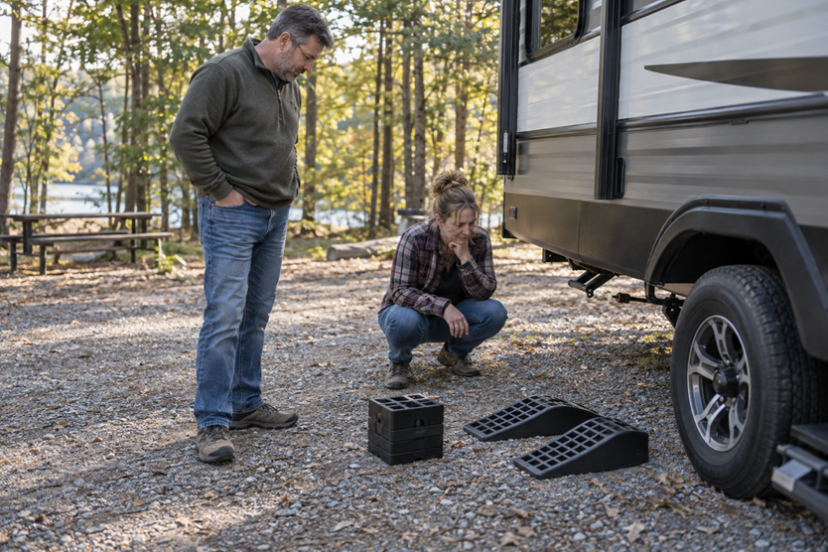
Choosing RV leveling blocks comes down to a few practical questions: how uneven your usual campsites are, what type of RV you have, how much adjustment you need, how much setup effort you are comfortable with, and whether the leveling system physically fits your tires and axle arrangement.
For many RVers, a simple set of interlocking blocks is enough. They are adaptable, easy to understand, and can be arranged differently as campsites change. Other RVers may prefer a curved drive-on leveler that provides more gradual height adjustment without building a block stack.
The goal is not to buy the most elaborate leveling system. It is to carry a system that works with your RV and solves the campsite problems you actually encounter.
When RV Leveling Blocks Are Worth Carrying
Leveling equipment becomes useful when one side of your RV sits lower than the other because of an uneven parking surface.
That can happen on:
- sloped campground pads
- gravel campsites
- older or uneven paved sites
- dispersed camping areas
- driveways
- sites with depressions beneath one or more tires
For a towable RV, side-to-side leveling is normally addressed while positioning the trailer. After that, front-to-back adjustments are handled using the equipment designed for that function on your particular trailer.
The important point is that leveling blocks have a specific job: raising the low side of the RV.
They should not automatically be treated as substitutes for wheel chocks, stabilizers, or other equipment that performs a different function.
You May Not Need to Replace the Blocks You Already Have
RV gear does not need to be upgraded simply because a different system exists.
If you already have a basic set of leveling blocks and they consistently handle the sites where you camp, there may be little reason to replace them.
Likewise, if most of your trips are to relatively level paved campsites, you may use leveling blocks infrequently enough that a straightforward system is all you need.
A different system becomes more relevant when you can identify a specific problem:
- you frequently need finer adjustments than your current blocks provide
- arranging blocks takes more effort than you want
- you regularly run out of usable blocks
- your present system does not work well with your RV configuration
- storage has become inconvenient
- your camping style has changed
Start with the problem, then decide whether another product actually solves it.
Check These Details Before Choosing a Leveling System
The differences between leveling products matter more when you connect them to the way you travel.
How Much Height Do You Usually Need?
Stackable blocks create height in increments.
You arrange them into a ramp or pyramid, drive onto the stack, check the RV, and reposition if necessary.
This can be perfectly adequate when you normally need modest corrections.
A curved drive-on leveler works differently. The tire moves gradually up the curved surface, allowing the height to change continuously within the product’s operating range.
Andersen specifies a leveling range of approximately 1/2 inch through 4 inches for its Camper Leveler.
That type of adjustment can be useful when you frequently want something between the fixed increments created by stacked blocks.
Your Tire and Axle Configuration Matter
Do not assume that a leveling system will physically fit simply because it is marketed for RVs.
Single-axle trailers, tandem-axle trailers, motorhomes, and other RV configurations create different space requirements.
This becomes especially important with curved levelers on tandem-axle trailers.
Andersen says its Camper Leveler works with tires up to 32 inches in diameter. The company also provides specific measurement and trimming guidance when closely spaced tires on multi-axle trailers leave insufficient clearance between them.
Measure your setup before buying rather than discovering a clearance problem at the campsite.
Consider How Much Repositioning You Mind Doing
Traditional blocks require some judgment.
You estimate the amount of lift needed, construct the stack, drive onto it, and see whether the result is correct. Sometimes you get it right immediately. Sometimes another adjustment is necessary.
That is not necessarily a weakness. It is simply part of using a modular block system.
For someone who camps occasionally, the difference may be unimportant.
Someone moving several times during a longer RV trip may place more value on a system that allows continuous adjustment while driving onto it.
Think About the Surfaces Where You Camp
Leveling equipment needs a suitable surface beneath it.
Tri-Lynx says its Lynx Levelers are intended for a variety of surfaces but specifically cautions about muddy ground prone to sinking and recommends checking for large rocks beneath the blocks that could concentrate pressure.
Loose ground, deep mud, sharp rocks, and other irregular surfaces deserve more attention than a smooth campground pad.
Do not assume that adding more blocks can compensate for an unsuitable or unstable surface.
Storage Can Matter More Than You Expect
Leveling equipment spends most of the trip stored in the RV.
Think about:
- how many pieces you need
- how they stay together
- whether a storage bag or carrying system is included
- how much compartment space they consume
- how easily you can retrieve them during campsite setup
Storage convenience is not as dramatic as load ratings or leveling range, but it is something you deal with on every trip.
Stackable Blocks and Curved Levelers Solve the Problem Differently
Most RVers comparing portable leveling products will encounter two broad approaches.
Interlocking Stackable Blocks
These blocks connect to create a low ramp or platform beneath the tire.
Their main strength is flexibility.
You can change the height and arrangement depending on the campsite, and additional blocks within a compatible system may allow you to adapt the setup further.
This style can make sense if you value:
- simple construction
- configurable arrangements
- familiar drive-on setup
- compact stacking during storage
- the ability to use different configurations from trip to trip
The tradeoff is that the height is determined by the block arrangement, so getting the RV where you want it can require another attempt.
Curved Drive-On Levelers
A curved leveler gradually raises the tire as the RV moves forward or backward onto it.
Instead of deciding the height before the tire reaches the blocks, you continue moving until the desired position is reached and then secure the setup according to the manufacturer’s instructions.
This approach can appeal to RVers who want:
- more gradual height adjustment
- fewer individual blocks
- less trial-and-error stacking
- a different approach to repeated campsite setup
Its biggest purchasing consideration is compatibility. Tire diameter and clearance between tires need to be checked carefully.
Neither type is automatically the correct choice.
The better fit depends on your RV and how you actually set up camp.
Three RV Leveling Systems to Compare
These products illustrate the differences within the category. They are not ranked, and the information below is based on published manufacturer specifications rather than firsthand testing.
Camco FasTen RV Leveling Blocks, 10-Pack — Model 21022
May be a good fit for:
RVers who want a conventional interlocking-block system with a simple way to keep the pieces together during storage.
Why it may fit:
Camco’s model 21022 includes 10 FasTen leveling blocks. Its distinguishing storage feature is the integrated T-handle system that keeps the stacked blocks together for carrying and storage. Camco currently identifies the set as SKU 21022 and lists a packaged shipping weight of about 9 pounds.
The modular design allows the blocks to be arranged according to the amount of leveling needed rather than limiting you to one fixed ramp shape.
That straightforward approach may suit RVers who are comfortable estimating the required height and driving onto a prepared stack.
Things to consider:
A stackable design means you need to decide how many blocks to use before positioning the RV on them. Fine adjustments may involve backing off and changing the arrangement.
Also confirm that the current manufacturer’s instructions are appropriate for your RV’s weight, tire configuration, and intended application rather than assuming that any plastic leveling block can support every RV.
Tri-Lynx Lynx Levelers — Model 00015
May be a good fit for:
RVers who want a modular block system with clearly published load, stacking, and configuration information.
Why it may fit:
The Tri-Lynx 00015 set contains 10 interlocking Lynx Levelers and comes with a nylon storage bag. Tri-Lynx lists each leveler at approximately 8 1/2 by 8 1/2 inches, with a 1 1/2-inch physical thickness that produces approximately 1 inch of lift when interlocked. The manufacturer publishes a 40,000-pound weight limit for the system and describes use beneath single or dual wheels, tandem axles, and jacks when configured as directed. The 00015 model designation for the 10-pack is also confirmed by current RV-parts listings.
Tri-Lynx recommends constructing a pyramid for leveling rather than simply creating an unsupported vertical stack.
That published configuration guidance may be useful for an RVer who wants a traditional block system and expects to use it in several different ways around the campsite.
Things to consider:
Like other interlocking blocks, the system works in defined increments rather than continuously adjustable heights.
Tri-Lynx also recommends using its leveling products with compatible Lynx components rather than mixing them with unrelated blocks, wood, rocks, or other materials.
That matters if you already own a collection of leveling equipment from another system and expect everything to interlock.
Andersen Hitches Camper Leveler — Model 3604
May be a good fit for:
Travel-trailer owners who want gradual height adjustment rather than building an interlocking block stack.
Why it may fit:
The Andersen Camper Leveler uses a curved drive-on design. As the tire travels farther onto the leveler, the RV rises gradually.
Andersen specifies adjustment from approximately 1/2 inch through 4 inches, compatibility with tires up to 32 inches in diameter, and use with trailers and RVs up to 30,000 pounds. Model 3604 includes a Tuff Chock that secures the leveler after the desired position is reached.
Its primary distinction is therefore not simply construction or brand. It changes how you perform the leveling adjustment.
Things to consider:
Tandem-axle clearance deserves particular attention.
Andersen notes that its leveler may require trimming when tires on a multi-axle trailer are too closely spaced. The company provides specific measurement and trimming guidance for those situations and lists the Camper Leveler as 6 inches wide.
Andersen also offers a separate rubber pad intended to add traction on hard surfaces when using the Camper Leveler.
Measure your tires and spacing before deciding that this style is compatible with your trailer.
Which Style Fits the Way You RV?
Rather than trying to identify a universal winner, match the system to the problem you are trying to solve.
You Want a Straightforward System for Ordinary Campsites
An interlocking block set such as the Camco FasTen or Tri-Lynx Lynx system is the logical category to investigate first.
Both let you change the arrangement according to campsite conditions without adding a mechanical adjustment system.
For someone who does not mind estimating height and occasionally repositioning the RV, that simplicity may be more valuable than continuous adjustment.
You Want Published Load and Configuration Guidance
Tri-Lynx provides particularly clear published specifications for its current Lynx Levelers, including its 40,000-pound system weight limit, block dimensions, recommended configuration, and use with different wheel arrangements.
That does not make it universally preferable, but it gives you specific information to compare against your RV and intended use.
You Want the Blocks to Stay Together in Storage
Camco’s FasTen design uses its T-handle to secure the set together rather than relying on a separate storage bag.
That may appeal to someone who values quick access in an RV storage compartment and does not want another loose bag of gear.
You Want Finer Height Adjustment
The Andersen design is the substantially different option among these three.
Its approximately 1/2- to 4-inch continuous operating range allows the driver to stop at an intermediate height rather than choosing a fixed block increment beforehand.
That advantage only matters, however, if the device fits your tires and axle spacing.
You Already Have Blocks That Work
Keep them.
If you are consistently able to level your RV without excessive setup effort, replacing functional equipment may accomplish very little.
A new leveling system makes more sense when it addresses a recurring inconvenience or compatibility problem you can clearly identify.
Common Mistakes When Buying RV Leveling Blocks
Choosing Before Looking at Your RV
Product descriptions cannot replace measurements.
Know your tire size, axle arrangement, available tire clearance, and relevant RV specifications before purchasing.
This is particularly important for curved levelers used around tandem axles.
Assuming More Blocks Are Automatically Better
A larger collection increases configuration options, but it also takes up additional storage space.
Base the amount you carry on realistic campsite conditions rather than preparing for every imaginable slope.
Mixing Incompatible Leveling Systems
Interlocking designs are intended to work as systems.
Tri-Lynx, for example, specifically advises against combining its levelers with unrelated brands or substitute materials because those combinations are not part of its tested configuration.
Follow the instructions for the system you own instead of improvising a taller stack.
Confusing Leveling With Stabilization
Raising a low wheel and reducing movement inside the parked RV are different jobs.
Wheel chocking is another separate function.
Use each component for its intended purpose and follow both the RV manufacturer’s setup procedures and the equipment manufacturer’s instructions.
Paying for Convenience You Will Rarely Use
A continuously adjustable system can make setup easier.
That does not mean every RVer needs one.
Someone taking several extended trips and changing campsites frequently may value quicker adjustment more than someone who makes a few weekend trips each year to level commercial campgrounds.
Frequency of use should influence how much complexity you are willing to buy.
Try the Simple Solution Before Buying More Gear
If you already own leveling blocks, use your next few trips as a test.
Pay attention to the actual problems that occur.
If you repeatedly find yourself backing onto blocks, pulling off them, rebuilding the stack, and trying again, a continuously adjustable system might solve a meaningful problem.
If the process takes only a few minutes and works reliably, your current setup may already be doing its job.
Likewise, if you are buying your first leveling system, you do not necessarily need the most specialized option. A basic modular system can teach you what kinds of campsite adjustments you encounter before you invest in something different.
Gear is most useful when it responds to experience rather than replacing it.
A Final Check Before You Buy
Before choosing RV leveling blocks or another portable leveling system, ask:
- Do I actually encounter campsites where leveling is a recurring problem?
- What type of RV and axle configuration do I have?
- What are my tire diameter and tire-spacing measurements?
- How much lift do I typically need?
- Am I comfortable stacking blocks in fixed increments?
- Would continuous adjustment materially simplify my setup?
- Does the manufacturer’s published capacity and compatibility information fit my RV?
- Will the system work on the surfaces where I normally camp?
- How much storage space am I willing to dedicate to it?
- Does my existing leveling equipment already solve the problem?
- Am I choosing features I will use, or simply buying a more elaborate system?
For many RVers, basic interlocking blocks remain a practical answer. For others, a curved drive-on system can reduce some of the trial and error involved in campsite setup.
The useful choice is the one that fits your RV, your campsite habits, and the amount of setup complexity you actually want.